

Happy Labor Day!
The regular Monday edition of the Legal Ethics Roundup will be back next week, but I wanted to interrupt our September return with something I hope many of you will consider being part of. I’m serving as Chair of the Planning Committee for the 52nd Annual ABA National Conference on Professional Responsibility, which will be held at the University of Houston Law Center June 2–4, 2027, in our beautiful new building. (Special thanks to Dean Len Baynes and his team for their assistance, along with generous support from the University of Houston’s Elizabeth D. Rockwell Center on Ethics and Leadership.)
We are now accepting program proposals. This conference brings together many of the people doing the most interesting work in legal and judicial ethics, lawyer regulation, professional responsibility, and the future of the profession. The LER has always been about sharing and strengthening those conversations, so I would especially love to see ideas from this community represented in Houston.
Read on for more information on how you can contribute.
Scroll to the end for a link to submit your proposal.
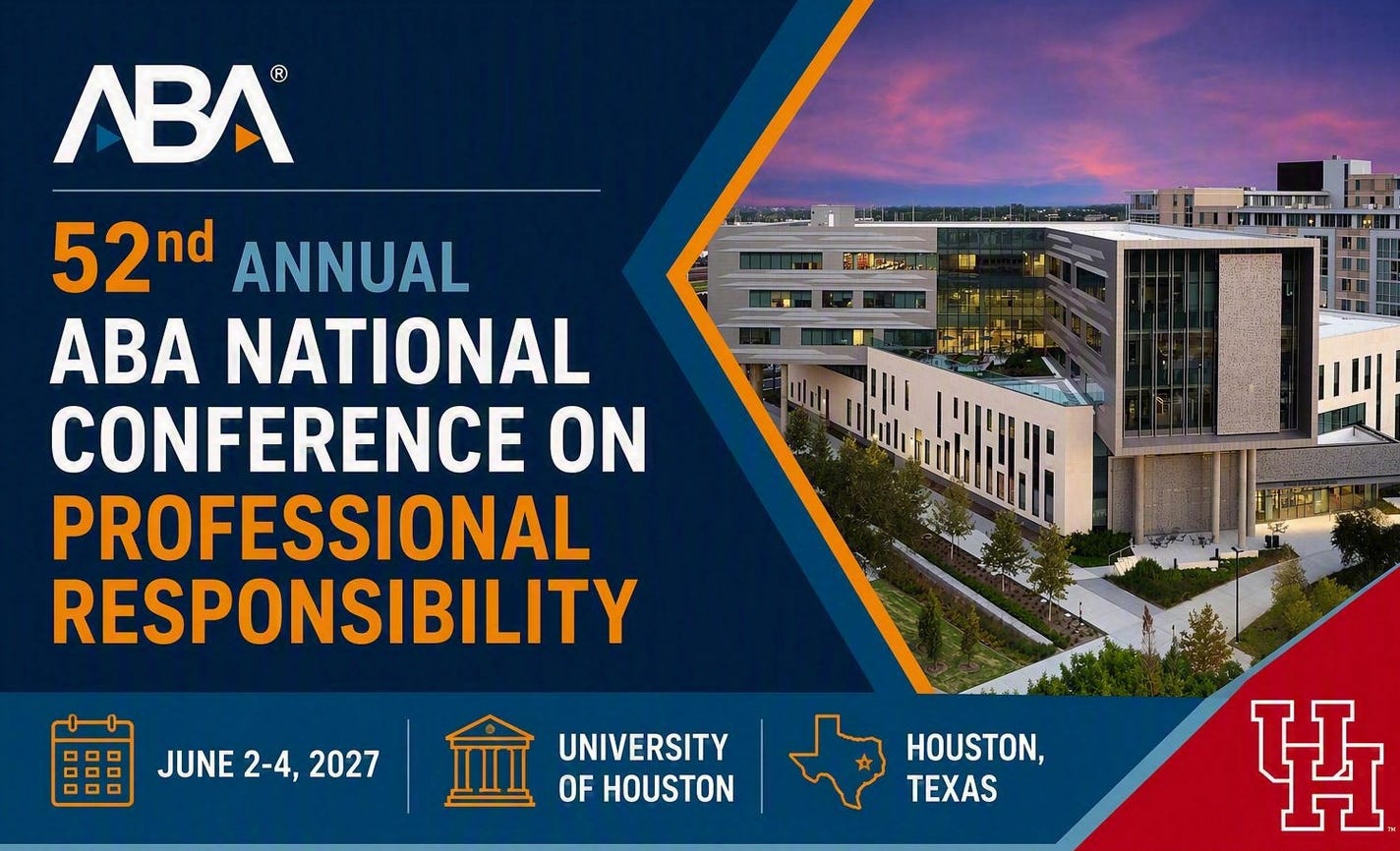
As Chair of the Planning Committee, I Invite You to Help Shape the Conference
Our committee is particularly interested in sessions that combine thoughtful analysis with practical application and equip attendees to address real-world problems. Strong proposals should move beyond introductory treatment by exploring difficult, emerging, or underexamined issues, engaging competing perspectives, and offering both substantive analysis and practical value for a sophisticated audience in an interactive format that actively engages attendees.
Proposals may be interdisciplinary, practice-focused, policy-oriented, empirical, comparative, or built around a case study, simulation, or regulatory challenge.
What Makes a Strong Proposal
Frames a clear, original, and consequential ethics, regulation, or accountability problem.
Explains why the issue is timely and why this audience should care now.
Offers depth appropriate for experienced professionals.
Builds meaningful exchange and participation among panelists and the audience.
Includes presenters with complementary expertise and, where relevant, differing viewpoints.
Identifies concrete learning objectives and practical takeaways.
Demonstrates attention to diversity of professional background, perspective, geography, and experience.
Program Design Expectations
Please design programs for active engagement by attendees.
Panels should ordinarily include no more than four participants in total, including the moderator.
Proposals should be suitable for continuing legal or judicial education where possible, with clearly stated educational objectives.
Presenters should avoid commercial promotion and should disclose relevant financial or professional interests.
Please note that the planning committee may request changes to a proposed title, description, format, length, speakers, or emphasis; may combine similar proposals; and may invite additional participants when doing so would strengthen the conference program.
Possible Session Formats
Plenary or Featured Panel (75 minutes). A moderated program for a broad conference audience addressing a major issue of field-wide significance. Ordinarily limited to four participants total, including the moderator.
Concurrent Breakout Session (60 or 75 minutes). An advanced, interactive session using a panel, workshop, case study, simulation, facilitated debate, or problem-solving format. Ordinarily limited to four participants total, including the moderator.
Roundtable or Regulatory Forum (45 or 60 minutes). A focused discussion designed for candid exchange among participants. Proposals should identify the central questions, the intended participants, and how audience participation will be structured.
Ethics Lab / Complex Problem Workshop (60 or 75 minutes). A hands-on session organized around a difficult hypothetical, emerging technology, institutional failure, disciplinary scenario, or judicial-ethics problem. Proposals should emphasize active analysis rather than a sequence of speeches.
Rapid Response / Emerging Issue Session (30 or 45 minutes). A tightly focused session on a fast-developing issue requiring timely analysis. The planning committee may reserve space for topics that emerge closer to the conference.
Your Brilliant Alternative. Innovative formats are encouraged. Describe the format, proposed length, and why it will serve the conference audience effectively.
Proposal Topic Ideas
Proposals may address any cutting-edge issue in legal ethics, professional responsibility, or judicial ethics. Examples of these include:
Artificial intelligence in law practice and judging, including competence, supervision, confidentiality, candor, bias, hallucinations, explainability, procurement, cybersecurity, authorship, and accountability for automated or agentic systems.
Ethics and regulation of sophisticated or complex practice, including multidisciplinary teams, global practice, alternative legal service providers, litigation finance, private equity, platform-based legal services, and novel business structures.
Judicial ethics and accountability, including recusal and disqualification, gifts and financial disclosure, extrajudicial activity, social media, court administration, judicial independence, discipline, and public confidence.
Lawyer discipline and regulatory design, including transparency, consistency, proportionality, diversion, remediation, data collection, prosecutorial discretion, procedural fairness, and cross-jurisdictional enforcement.
Conflicts of interest in complex organizations, government practice, law firms, corporate families, lateral mobility, outside counsel relationships, and representations involving advanced technology or data.
Professional responsibility in high-stakes advocacy, investigations, election law, government service, national security, crisis lawyering, public-interest litigation, and matters involving threats to democratic institutions or the rule of law.
Ethics of legal education, admission, licensing, continuing competence, experiential learning, , and preparation for rapidly changing professional roles.
Access to justice, unauthorized practice, regulatory innovation, fee arrangements, limited-scope representation, and the ethical design of scalable legal services.
Comparative, empirical, behavioral, or interdisciplinary approaches to lawyer and judicial regulation, including insights from technology, sociology, psychology, economics, organizational governance, and public administration.
The Planning Committee is looking forward to reviewing your submission!
Want the weekly Legal Ethics Roundup to hit your email inbox as soon as it is published on Monday mornings? Subscribe now for free.